After the face casting last lesson we tried body casting - this lesson was to be used as a trial run before doing a proper set of body casts. The whole point of us experimenting with body casting was that we were designing a mural for the construction department, and the mural it to be made of a collection of side body profiles.
Before we did anything we had to wrap our models (Lauren, Emma and Amy) up in an ridiculous amounts of cling film, to make sure that they protected from the plaster. Which I don't mind saying was very awkward in some places.
 |
| A Sleeping Lauren |
 |
| A Face of Beauty, Amy |
 |
| Emma Posing Like a Professional |
I was working on Lauren and tried my best to get as much done as possible but it was hard to try and cover her as quick as possible but again I was surprised on how quick the chemical reaction happened in plaster and had to stop even though I had more to do.
 |
| Final Product |


Research!!!
After these practise runs we had a look at artists who did a lot of work by using the body casting method, for example Antony Gormley. Gormley is a sculptor most famous for the "Angel of the North" he does a variety of sculptures from body cast and then casts them in metal and many of his work our based form his own body casts. Gormley has said that he attempts to show the body not as an object but a place that can be a common condition that all humans identify with.
I really like Gormley's work it has a kind of epic feel to his work and since I am personally a fan of how the texture metal can be used in a variety of art, I find that Gormley's metal casting is very interesting.
 |
| "Angel of the North" 2008 |
 |
| "Another Place" - 1997 |
 |
| "Gay Liberation" 1980 |
 |
| "Street Crossing" - 1992 |
 |
| "Rush Hour" - 1983. Bronze Cast. |
When looking at some of Segal's plaster sculpture I thought they looked a bit eerie and I also thought that the plain white and the sort of limp lifeless look that they have makes them look a little like ghosts - since they look a little disconnected.
To look at a bit of art history we also looked at the Eglin Marbles and the current situation around them - the Eglin Marbles were a collection of Ancient Greek marble sculptures that were in a frieze/mural that surrounded the top of the Parthenon in Greece. We looked at these because this kind of mural is similar to the idea that we had for the mural for the construction department - I personally loved looking at this sort of historical influence on our work since art history is something I'm really passionate about and is most likely what I will go on and study at university. The Eglin Marbles, along with every other Ancient Greek statues were originally painted with bright colours, but those at the British Museum in the 1800's scrubbed the remnants of the paint off and 'restored' it to the marbles original state of pure white - which is what was perceived to be the 'classical' look of ancient statuary.

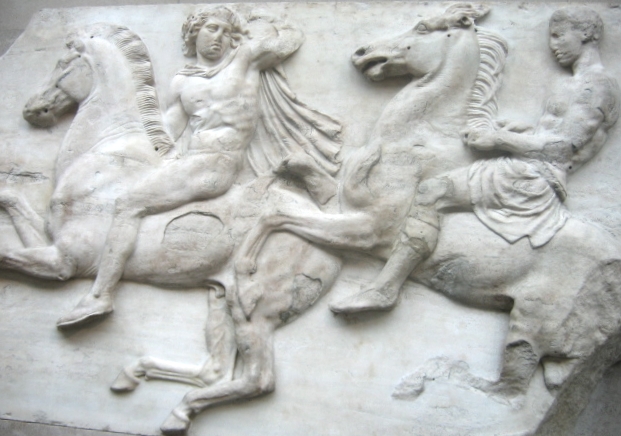

After looking at the Eglin Marbles and the Ancient Greece influence on our work I thought that our casts reminded me of ash body casts that were found in the ruins of Pompeii, the sort of stiff looking bodies that were slightly rounded and looked lifelike, but not too lifelike (if that make sense.)

I noticed that these ash bodies from Pompeii gave me the similar eerie feeling as Segal's body casts did - I wonder if there was any connection?

No comments:
Post a Comment